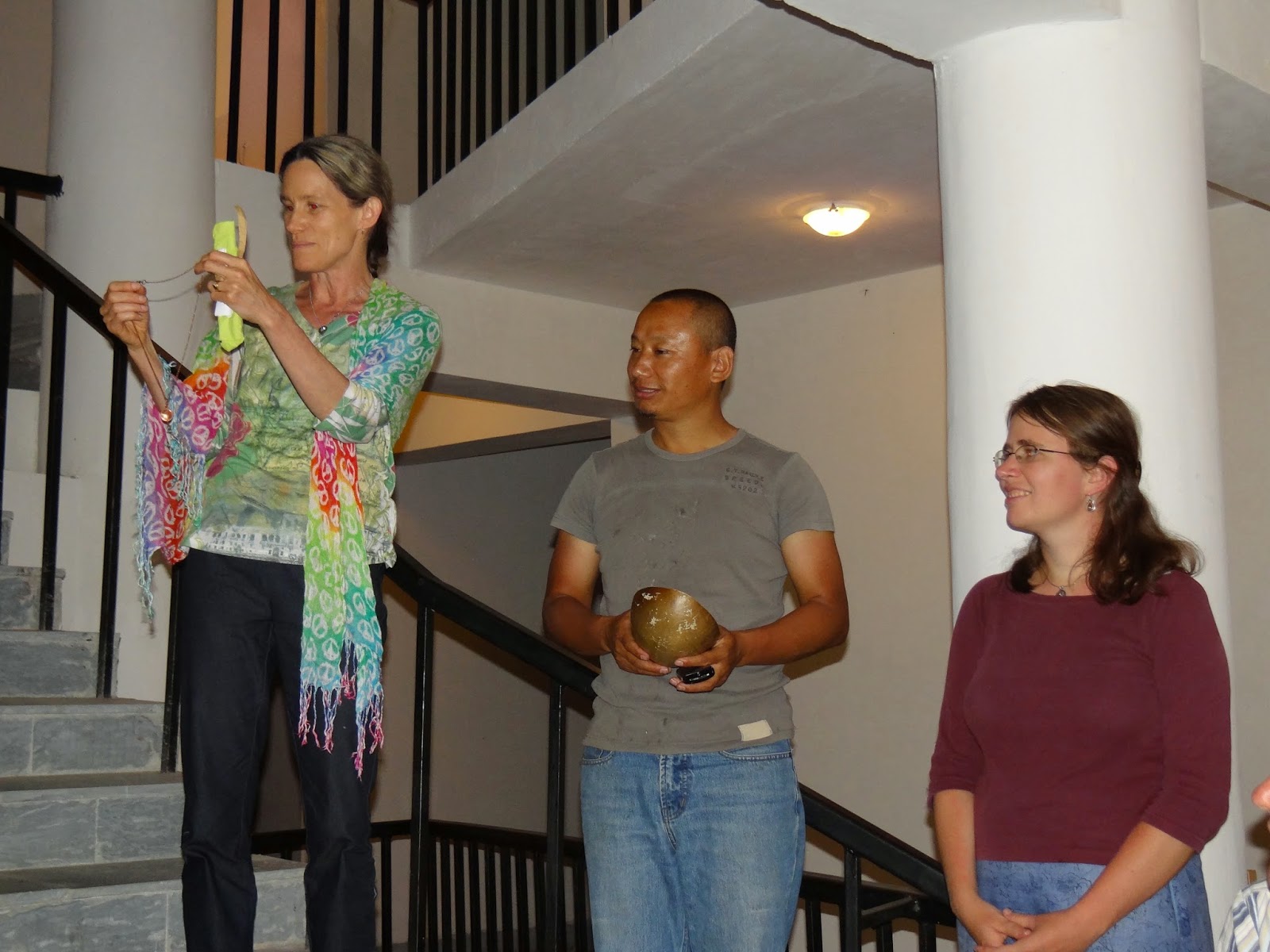
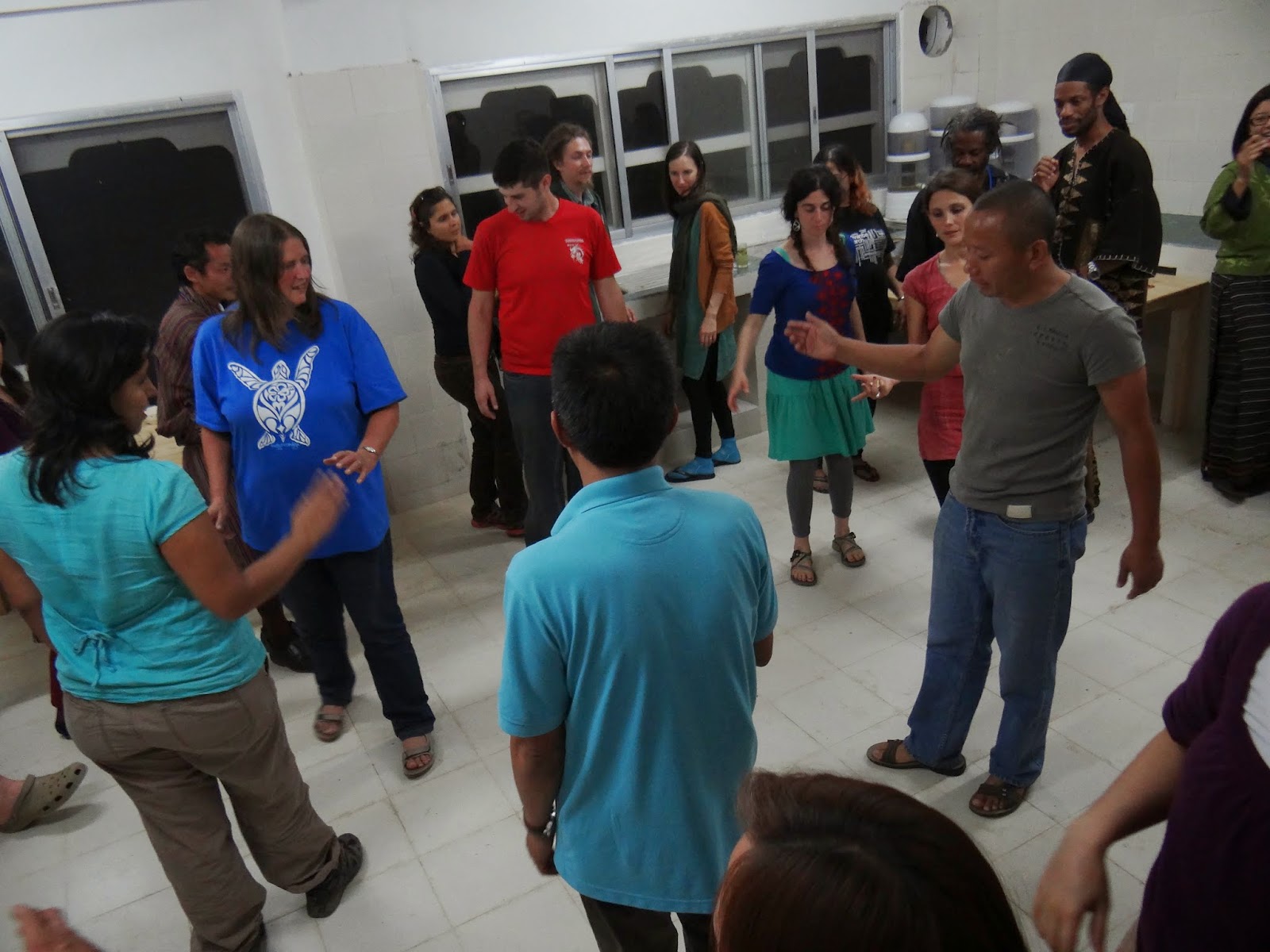
Written by Meadhbh Costigan, from Ireland, one of the workshop participants
The
opening ceremony of the pre-congress workshop began with a traditional
Bhutanese Marchang ceremony, which involved chanting and an offering of rice
beer to local deities. The keynote speaker of the ISE pre-congress event was
Dr. Dorji Wangchuk, the Director General of the College of Natural Resources (CNR),
Royal University of Bhutan.
 |
| Dr. Dorji Wangchuk, photo by Attila Paksi |
The workshop was titled; “walking across
generations towards peaceful coexistence”. Core values of the Bhutanese
community were addressed and their relationship with Buddhism was highlighted.
The culminating effect was an enlightened perspective on how we might learn to
promote happiness in their own lives.
Buddhism in Bhutan
The
presentation began with a statement which underlies Buddhist philosophy; help
others, and if you cannot, then do no harm. This is one of the teachings of His
Holiness the Dalai Lama. We were then told that Buddha was a Great Teacher.
Buddha is not God.
Dr.
Wangchuk explained to us, that from a Buddhist perspective, we had gathered together
in Bhutan to reconnect with one another as we all had shared relationships in
countless passed lives. As different beings, our paths cross throughout time
and space. Again. And again. Unto infinity. This pattern is known as Karma, a
principal which addresses the interdependent nature of life. Karma is a gift
allowing us another opportunity to reconnect with those we have loved before. A
text by His Holiness the Dali Lama XVI was recommended for further reading,
entitled; “How to Practice: The Way to a Meaningful Life” (Hopkins 2002).
Gross National Happiness (GNH)
These
words were followed by a definition of Gross National Happiness, which is a
government directed development course aiming to achieve a standard of health
and happiness for its community members. The Gross National Happiness plan is
being implemented through the provision of; governance, education, medical care
and communications.
Holistic Education
In
Bhutan, education is understood as a universal
human value that promotes an advanced understanding of relationships at
three scales; the internal (the individual), the social (the community), and
the external (physical environment). The term self-development could be used to
encompass this rigorous and continuous practice which improves understanding
about oneself, one’s family and by extension the world at large. The cultural
ideal is that an academic institutions provide a holistic education, by
providing a forum for self-development. So human
value education is about co-existing in harmony and peace.
 |
| The “Four Harmonious Friends”, wallpainting at CNR, Lobesa, photo by AnnaVarga | | |
|
Emic healthcare systems
The
discussion then moved to Pranic healing, a non-invasive self-healing medical
practice. Pranic healing uses the life-force
of the body to promote well-being. Those which practice Pranic healing
acknowledge that there are energy centres in the body which can be cleaned or manipulated, ultimately
resulting in less health problems. In Bhutan, patients have the option to be
treated by biomedical doctors or traditional healing practitioners. The speaker
recommended a text detailing Pranic healing (Sui 1987).
GNH and the Individual
When
you see me I am actually one person, but I exist as two; the body, and the
self. The body is an instrument directed by the self. In order to have peaceful
co-existence at the individual level, we must learn not to abuse the body or
the self (through substance abuse, bad relationships etc.) Co-existence at an
individual level will bring peace and happiness. When the state of peace and
happiness is reached by one person, it can be extended to the family, then to
the wider community, and will spread throughout to the world. The aim is
achieving world peace and the method is of a spiritual nature.
 |
| Prayer flags in the woodland at Dochula Pass, by AV |
On
a personal level, promoting GNH boils down to setting limits to our own greed.
It is necessary to take the responsibility to be satisfied with one’s state.
Without setting this limit we cannot be happy, as one day we may desire the
moon, then the sun, then the stars in the sky.
The
Director General questioned the necessity for unlimited desires and negative
emotional states, including; self-centeredness, jealousy, lust, and hunger.
Each of us has the capacity to navigate one’s own internal cosmos. His point
being, if we could acknowledge that all we ever have is the “now”, then perhaps
we would be freed from these base emotional states. Perhaps one would instead
decide to be happy.
In
Buddhism, any state of disharmony is considered man-made. So it follows man has
the capability to promote harmony, within himself, and the wider world. A
beautiful idea. Love is considered a redemptive transformative power. A loving
person wishes peace and well-being to all sentient life-forms. These insights
underlie the practice of meditation.
 |
| Butter lamps at Dochula pass, photo by AnnaVarga |
Conclusion
To
conclude Dr. Wangchuk invoked the children’s rhyme, Row, Row, Row your Boat, and asked: “A dream? What is life all
about?” Every passing moment is a dream. This simultaneous appreciation for and
detachment from the world is a dualism in Buddhism, which is widely
acknowledged to be one of the most difficult for an outsider to understand.
Footnote
The
worldview expressed during the commentary reminded me of the hippie movement
popular in the counter culture during the 1960s. Those who celebrated this
life-style were influenced by Eastern esoteric practices; talking “peace”,
burning incense, eating vegetarian, and smoking cannabis For me, this shift in
popular thinking is epitomised in the music of the Beatles. I would like to see
such a cultural revival in my part of the world. But perhaps it is within myself
that I should search for this peaceful and harmonic state.
Learning
about the lives of the congress participants, I realised there is no “typical
ethnobotanist.” A lot of us choose to live the ideal we hold in our minds eye.
I found this very inspiring. I have long worked to “be an ethnobotanist”, but I
am now realising that for some it is not just a profession, but also a
philosophy and a life-style. If I were to turn the anthropologists spy glass on
the ISE community, I would say; we are a compassionate people searching for an
alternative and mindful way to participate in the world. Wouldn’t we say the
same about the Bhutanese? For me the address seemed like an appropriate lesson,
as we struggle to take responsibility for who we are as individuals and as a
species.
 |
| Meadhbh Costigan with Incense censer in Bhutan |
References
Hopkins,
J (Ed.). (2002) How to Practice: The Way to a Meaningful Life. New York, USA:
Atria Books.
Sui,
C. K. (1987) Miracles through Pranic Healing. Philippines: Institute for Inner
Studies Publishing Foundation, Inc.
 After
arriving in Lobesa in the dark of the night and retiring to bed following
dinner, we engaged in 2 days of intense discussion, debates and considerations.
This occurred indoors while the monsoon rains blessed the farmers who were
anxiously waiting for it. However, on the day of our field visit, we awoke to a
warm and bright sunny day that seemed to present itself specifically for us.
After breakfast we walked down the steep slopes boarded the buses for our long
awaited journey. Driving through the villages was remarkable, with many smiling
faces and interesting passersby that almost always greeted us with a smile and
a wave. A brief stop at on the outskirts
of the hospital allowed us the chance to grab some locally made cheese and get
a few photo ops. The next location was the Lingmuteychu Watershed. It allowed
us to appreciate the importance of water to the survival of the local
communities. What was intriguing was the way in which water is shared between
the communities that live at various altitudes and the dynamics that surround
this phenomenon.
After
arriving in Lobesa in the dark of the night and retiring to bed following
dinner, we engaged in 2 days of intense discussion, debates and considerations.
This occurred indoors while the monsoon rains blessed the farmers who were
anxiously waiting for it. However, on the day of our field visit, we awoke to a
warm and bright sunny day that seemed to present itself specifically for us.
After breakfast we walked down the steep slopes boarded the buses for our long
awaited journey. Driving through the villages was remarkable, with many smiling
faces and interesting passersby that almost always greeted us with a smile and
a wave. A brief stop at on the outskirts
of the hospital allowed us the chance to grab some locally made cheese and get
a few photo ops. The next location was the Lingmuteychu Watershed. It allowed
us to appreciate the importance of water to the survival of the local
communities. What was intriguing was the way in which water is shared between
the communities that live at various altitudes and the dynamics that surround
this phenomenon.